Article
What is a function in time tracking and why is it important?

Summary
- A function is a defined work task or role that can be linked to hours, costs, and invoicing.
Introduction
A function in time tracking is a category that describes what the work is about. It can be a task such as "assembly", a role such as "project manager", or a type of activity such as "meeting with a client". Functions are used to differentiate between various types of work within the same project, allowing the company to gain better insight into how time is utilized. For consultants and craftsmen who bill hours, this is especially important, as different functions often have different hourly rates. A good time tracking system allows you to link each hour to both project and function, ensuring that the timesheet is precise and the invoicing basis is documentable.
Why functions make time tracking more useful
When you track hours without specifying a function, you only get an overview of the total number of hours per project. This may be sufficient for simple tasks, but as soon as multiple people are involved or the work varies in price, function categorization becomes necessary. For example, an electrician may have one hourly rate for assembly and another for troubleshooting. Without linking hours to the correct function, the invoicing basis becomes difficult to explain, and the company loses valuable insight into what takes the most time. Many Norwegian companies register hours in Excel or other solutions, but quickly discover that the overview disappears as the project grows. Functions solve this by making hours searchable, filterable, and easier to report on.
When creating a timesheet or invoice, function categorization allows you to show the client how time has been spent. Instead of "40 hours on project X", you can show "20 hours design, 15 hours development, 5 hours meetings". This provides transparency, builds trust, and makes it easier to justify the hourly rate. For the company itself, it provides a basis for assessing whether resources are being used correctly. Perhaps too much time is spent on administration, or maybe a specific type of task takes longer than budgeted. Without function categorization, this insight becomes impossible to extract.
How functions are used in practice
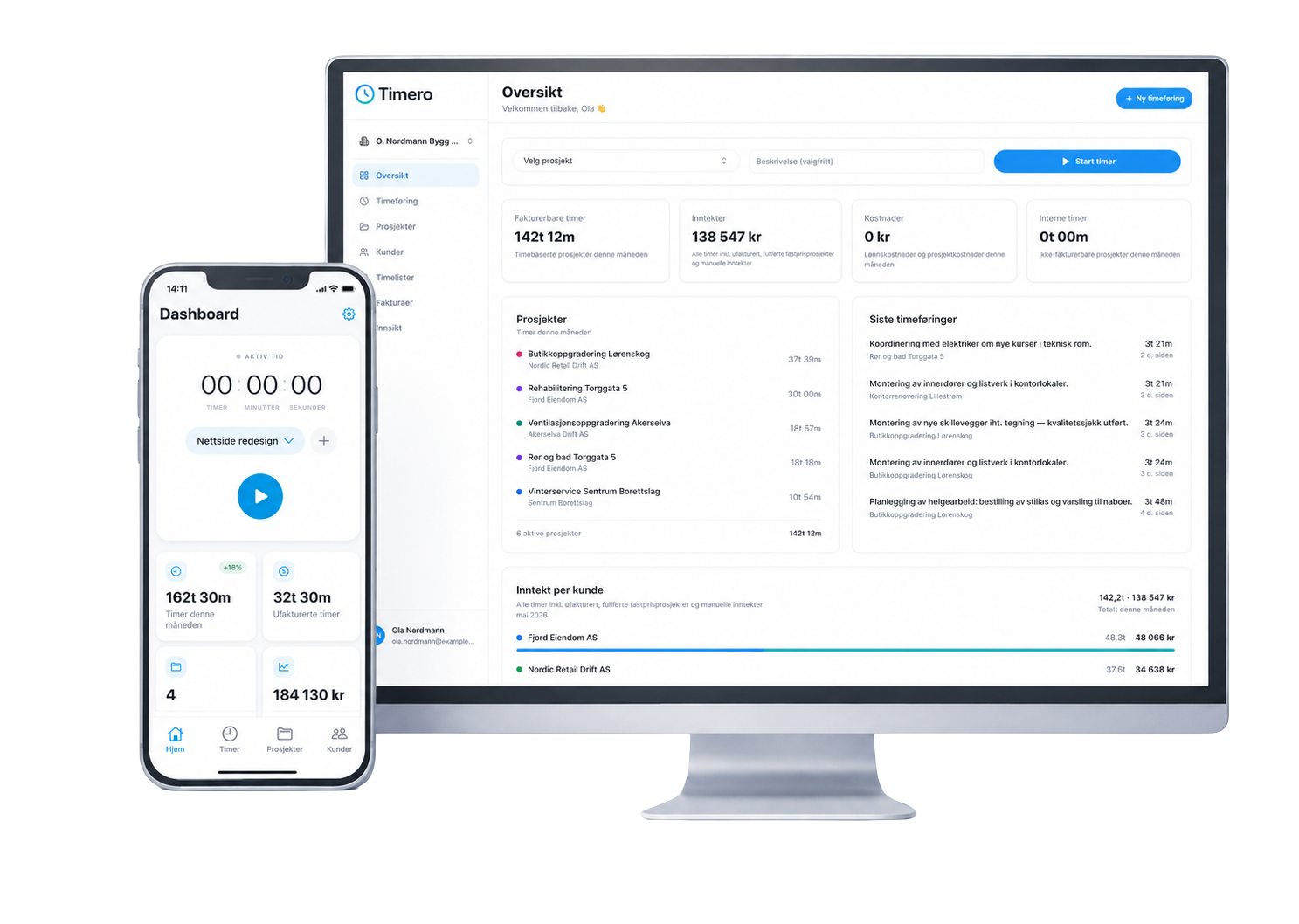
In Timero, you can register hours with both project and function. This means that each hour has two dimensions: what it pertains to (the project) and what it is about (the function). When creating a timesheet or invoice, you can group hours by function and provide the client with a clear summary. The system automatically calculates the correct hourly rate based on which function the hour is linked to, so you don't have to do it manually.
For consultants working with multiple clients, functions are especially useful. A consultant may have functions such as "consulting", "analysis", "report writing", and "follow-up". Hours are registered along the way, and when the month is over, the consultant can generate a timesheet showing how much time has been spent on what. This makes it easier to invoice hours to clients and gives the consultant insight into how their workday is distributed.
For construction companies, functions can relate to activities such as "transport", "material handling", "assembly", and "cleanup". This allows for documentation of all billable hours, including those that are not directly related to on-site work. Many clients desire this type of detail, and a system that handles functions makes it easy to deliver.
Examples of common functions in various industries
- Consulting industry: Consulting, analysis, meetings, report writing, testing, training
- Construction: Assembly, demolition, transport, cleanup, troubleshooting, follow-up
- Design and creative fields: Concept development, design, revision, client meetings, production
- IT and development: Development, testing, documentation, support, deployment, meetings
- Project management: Planning, coordination, follow-up, reporting, budget control
- Administration: Invoicing, customer service, archiving, internal communication
Functions and project economics
When you have a good categorization of functions, you also gain better control over project economics. You can see which functions take the most time and compare it with what was budgeted. If the design phase takes twice as long as planned, you can adjust the budget or price for the next project. Without function categorization, this insight becomes difficult to obtain. Timero provides an overview of both hour budgets and actual hours per function, allowing you to track progress along the way and adjust before the project goes over budget.
For companies with multiple employees, functions are also important for payroll reporting and billability. Some functions are billable, while others are internal. Distinguishing between them gives the company an overview of how much work time can actually be billed to clients and how much goes to internal administration. This is a key metric for profitability, and you can only achieve it if hours are linked to the correct functions.
Frequently Asked Questions
What is the difference between a project and a function?
A project is the entire assignment or work for a client, while the function describes what you do within that project. You can have one project with multiple functions, such as design, development, and meetings. Functions provide more detailed insight than the project alone.
Do I need functions if I work alone?
It depends on whether you need insight into how your time is spent. If you have different types of tasks with different prices, or if you want to see how much time goes to administration versus billable work, functions provide good value. Otherwise, you may manage with just the project.
Can I change the function of an hour afterwards?
Yes, in Timero you can easily edit hours and change the function if you have registered incorrectly. This provides flexibility without losing traceability.
How many functions should I have?
This varies by industry and complexity. Start with 3–5 functions that cover your main activities. You can add more as the need arises. Too many functions can make time tracking unnecessarily complicated.
Can I use functions to distinguish between billable and internal hours?
Yes, this is a common use. You can have functions like "Billable Development" and "Internal Administration", and the system will provide you with an overview of the distribution. This makes it easy to report billability.
How do functions affect my timesheet?
The timesheet can be grouped by function, allowing the client to see a summary of how time has been spent. This provides more professional documentation and makes the invoice easier to understand.
Can I have different hourly rates per function?
Yes, in Timero you can set your own hourly rates per function. When you register an hour, the price linked to that function is automatically used. This ensures correct invoicing without manual adjustments.