Article
Is time tracking mandatory in Norway?

Summary
- Time tracking is mandatory in Norway for all companies with employees, according to the Working Environment Act § 10-6 and the Working Hours Regulation § 6.
Yes, time tracking is mandatory for companies with employees in Norway. The requirement is based on the Working Environment Act § 10-6 and the Working Hours Regulation § 6, and applies regardless of whether the company is small or large. Employers must keep track of when each employee starts and ends work, the total number of hours per day, and any overtime or inconvenient working hours. The purpose is to ensure that employees receive correct pay, that working hour regulations are followed, and that the Labour Inspection Authority can verify that the business operates in accordance with the regulations. Many companies use digital time tracking systems to gain better oversight and reduce the risk of errors. Timero makes it easy for both employees and employers to record and approve hours in a way that meets legal requirements.
What does the Working Environment Act say about time tracking?
The Working Environment Act § 10-6 requires employers to keep track of the actual working hours of each employee. This requirement applies regardless of whether the work is done in an office, in the field, or from home. The law also stipulates that the information must be available to the Labour Inspection Authority during inspections. The Working Hours Regulation § 6 elaborates on the requirement by specifying that the record should include start and end times for each working day, total hours worked, and any overtime or special work. The aim of the requirement is to ensure that working hour regulations are followed, that employees are paid correctly, and that employers have a solid basis for wage calculations and health and safety follow-up. For small businesses, it may seem cumbersome, but in practice, it is about having a simple, systematic overview that provides security for both the employer and the employee.
Why time tracking is important for small businesses
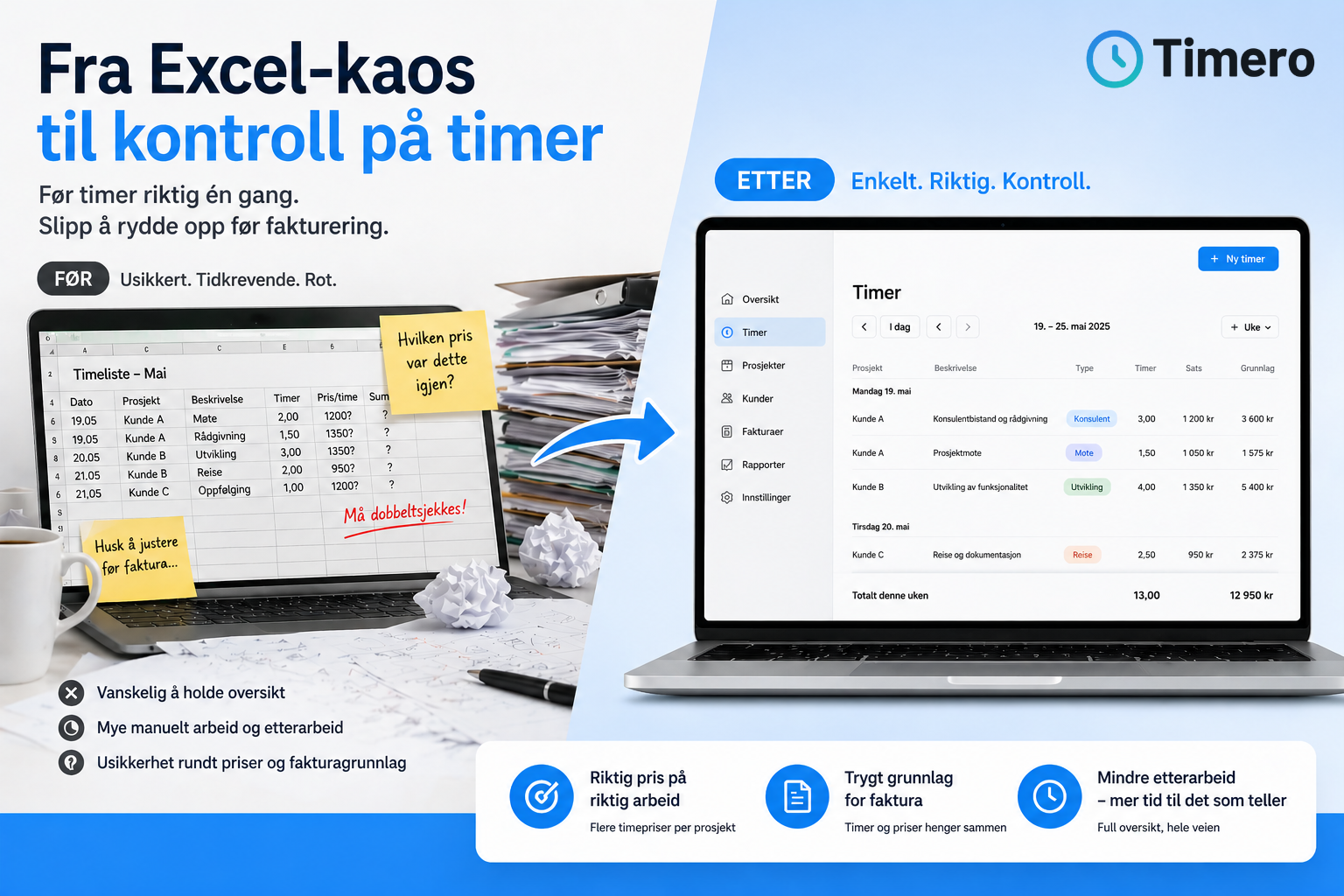
Many small businesses view time tracking as administration they would prefer to avoid. However, accurate time reporting saves both time and money in the long run. Without an overview of hours, it becomes difficult to know if projects are profitable, if employees are working too much overtime, or if the invoicing basis is correct. When time tracking is in place, the business gains insight into where time is actually spent, what constitutes billable work, and which tasks take longer than expected. This makes it easier to adjust prices, capacity, and resource use. For businesses with hourly paid employees, time tracking is also crucial for establishing the correct wage basis. With a system that consolidates time tracking and project oversight in one place, the business avoids using Excel sheets or manual counting, which can easily become imprecise and time-consuming.
What should time tracking include?
To meet legal requirements, time tracking must include the following information:
- Start and end times for the workday
- Total number of working hours per day
- Any breaks that are not counted as working time
- Overtime, evening work, night work, or Sunday work
- Project or client that the time is spent on, if relevant for invoicing basis or project economy
- Name of the employee and date
The information must be kept for at least three years and be available for inspection by the Labour Inspection Authority. The system does not need to be advanced, but it must be reliable and easy to use. Timero makes it easy to register hours directly from a mobile device or PC, with automatic summation per day, week, or month. Employees log hours as they go, and the manager approves or adjusts as needed before payroll processing.
Digital solutions reduce the risk of errors
Many businesses start with paper-based time sheets or Excel sheets. This works for a while, but quickly becomes cumbersome as the number of employees or projects increases. Manual systems also carry a higher risk of errors, forgotten hours, or hours that are never invoiced. A digital time tracking system consolidates all information in one place, provides better oversight, and makes it easier to export data to payroll or accounting. With real-time updates, both employees and managers can see what has been recorded, and any discrepancies are quickly detected. Timero allows employees to log hours directly in the app, while the business gets an automatic overview of billable and non-billable work. This ensures that no hours are lost, and that the invoicing basis is always up to date.
What happens if the business does not track time?
Missing or incorrect time tracking can lead to several consequences. The Labour Inspection Authority can issue orders to rectify the situation and, in some cases, impose fines for violations. If the business does not have an overview of working hours, it also becomes difficult to document compliance with the Working Environment Act, which can create problems in complaint cases or labor disputes. Additionally, the business loses important management information. Without an overview of hours, it becomes impossible to know if projects are profitable, if employees are working too much overtime, or if the invoicing basis is complete. Accurate time tracking is therefore not only a legal requirement but also an important tool for operating profitably and safely.
Frequently Asked Questions
Who is responsible for time tracking?
The employer is responsible for ensuring that time tracking is carried out and documented in accordance with the Working Environment Act. The employee must log hours, but it is the employer who must ensure that the system exists, is used correctly, and that the data is stored for at least three years.
Must all businesses track time?
Yes, all businesses with employees must track time. The requirement applies regardless of company size, industry, or whether employees work full-time or part-time. Self-employed individuals without employees are not legally required to track time, but many still choose to log hours to ensure invoicing basis and better oversight.
Can the business use Excel for time tracking?
Yes, Excel can be used for time tracking as long as the overview contains all required information and is stored in accordance with the law. In practice, Excel quickly becomes cumbersome as the number of employees or projects increases, and it carries a higher risk of errors. A digital system provides better oversight, automatic summation, and easier export to payroll and accounting.
What happens if an employee forgets to log hours?
If an employee forgets to log hours, the time tracking must be corrected as soon as the error is discovered. The employer is responsible for ensuring that the overview is correct and should have routines for follow-up and approval of hours before payroll processing. With a digital system, the business can send reminders and receive alerts about missing entries.
Must the business store time tracking records?
Yes, time tracking records must be kept for at least three years and be available for inspection by the Labour Inspection Authority. This applies to both digital and paper-based systems. The business must be able to present the overview upon request, and it must be readable and complete.
Can time tracking be used as an invoicing basis?
Yes, many businesses use time tracking as a basis for invoicing customers. The time logging must be linked to the customer and project so that the business can easily invoice hours based on what has actually been performed. Timero makes this easy by allowing the business to go directly from time tracking to invoicing basis.
Is it mandatory to use electronic time tracking?
No, there is no requirement for an electronic solution. The law only requires that the overview exists, is correct, and is stored properly. However, most businesses will save time and gain better control by using a digital time tracking system that provides automatic summation, easy approval, and export to payroll.